
A federal rule tied to domestic air travel will soon add a new cost for anyone who reaches a TSA checkpoint without a REAL ID or another approved document. Beginning February 1, 2026, travelers presenting a non-compliant ID will be required to pay a $45 fee to use TSA PreCheck.ID, a system that verifies identity for a ten-day travel period.
The policy follows the nationwide enforcement of the REAL ID Act, a law passed in 2005 and fully implemented this year after long delays. The change affects the small share of passengers who still rely on licenses that do not meet federal standards, and it introduces a direct cost at security for those who need alternative verification. Reactions have moved quickly from mild confusion to raised eyebrows because the stakes affect anyone who tries to board a domestic flight with the wrong card.
What Triggered The New Fee
The Transportation Security Administration originally suggested a lower fee, but internal reviews revealed higher costs associated with the modernized identity process. The agency explained that the charge shifts the expense to travelers instead of taxpayers, and it expects the move to cut down on the remaining group that still uses non-compliant IDs. Federal officials report that more than 94 percent of passengers already carry an acceptable document.
The REAL ID Act became law in 2005 after security recommendations issued in the years following the 9/11 attacks. The rollout stalled for years due to state readiness, technology issues, and later COVID-era delays. Enforcement finally took hold this year, and the fee arrives as the next step in making compliance routine. People 18 and older need a qualifying ID for domestic flights, and temporary driver's licenses do not count.
What Counts As Acceptable Identification
A REAL ID carries a star in the upper corner and follows federal standards for identity verification. States issue them through their motor vehicle agencies, and each state sets its own process and pricing. Some states charge the same as a standard renewal, while others place an added cost on it. Applicants generally bring proof of name, birth date, social security number, two pieces of address documentation, and proof of lawful status. Many states ask for a primary document, such as a passport or birth certificate, during the appointment.
Travelers who prefer other options have a long list to choose from. TSA accepts United States passports, passport cards, trusted traveler cards, permanent resident cards, border crossing cards, Defense Department IDs, tribal IDs, including enhanced cards, PIV cards, foreign passports, Canadian provincial licenses, transportation worker credentials, and several employment and mariner cards. TSA also accepts digital IDs stored in Apple Wallet, Google Wallet, and Samsung Wallet at many airports. Children under 18 who fly with an adult do not need identification for domestic trips.
How Confirm.ID Works For Passengers
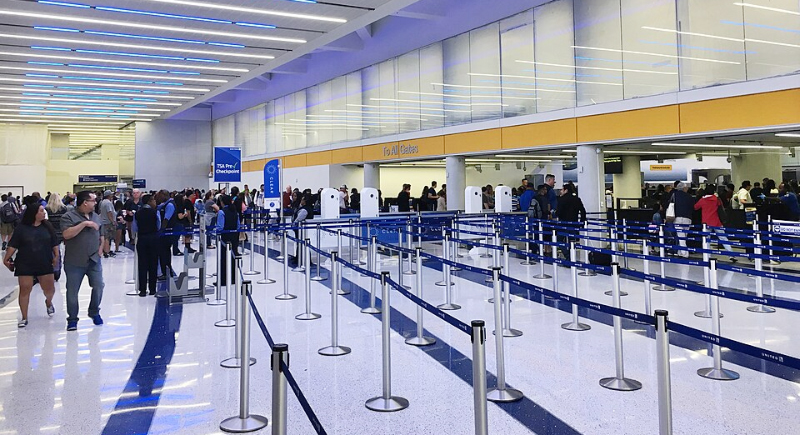
Image via Wikimedia Commons/Edward Russell
People who reach the airport without a REAL ID or another approved document get routed into Confirm.ID. The system attempts to verify identity using available records, but paying the $45 fee does not guarantee approval. TSA officials say those who cannot be verified may be turned away. If the system confirms identity, the clearance lasts ten days, which covers round-trip or short travel windows.
TSA encourages travelers to pay online before arriving at the airport to cut down on delays. Payment can also occur at the airport through provided links, though the agency warns that the process may take as long as 30 minutes. The new fee raises the stakes because it adds cost, time, and uncertainty to something people treat as automatic. The requirement also ties into broader security goals that shaped air travel over the past 20 years.