
British Columbia’s desert landscape has its share of unusual features, but Spotted Lake draws some of the most consistent attention. Each summer, its surface breaks into a series of colored pools that appear to be designed rather than natural. For outsiders, the view creates the same question every season: how does a lake end up looking like a palette of floating spots?
A Stunning, Seasonal Shift
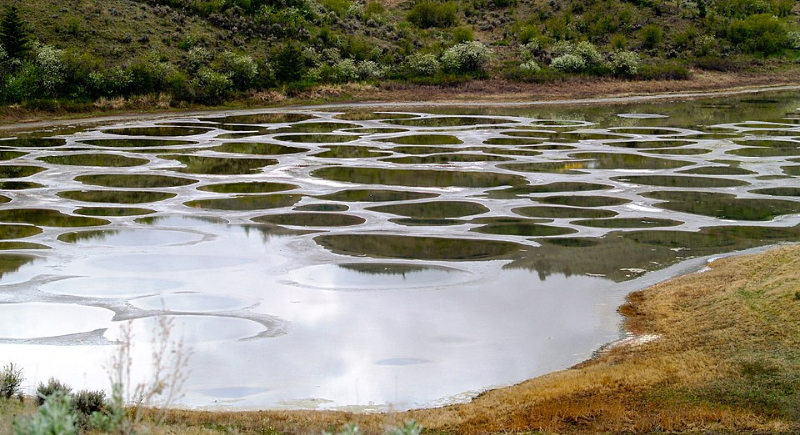
Image via Wikimedia Commons/Jack Borno
Kliluk is located between the Okanagan and Similkameen Valleys, areas known for hot, dry summers. For most of the year, the water appears unremarkable. However, when temperatures rise, evaporation occurs, and minerals concentrate in the shrinking waterline, which forms hundreds of shallow pools. Each pool has its own unique mineral composition, resulting in colors that shift between yellow, green, and blue.
Researchers have recorded high levels of magnesium sulfate, calcium, and sodium sulfates along with traces of titanium and other elements. The patterns change depending on rainfall, snowmelt, and heat.
Science Meets Surrealism
For all its unusual looks, the setting is not lifeless. A microbial presence has adapted to conditions that would overwhelm most organisms. Its existence has led some scientists to compare Kliluk to ancient Martian lakes that may have held similar mineral signatures. It’s not a one-to-one match, but the high salinity and shallow basins give researchers a rare chance to study an Earth-based stand-in.
These circles also have a practical side. During World War I, laborers harvested salt here to supply materials for ammunition. Reports describe workers moving roughly one ton per day. The process changed the lake’s appearance until it eventually returned to its natural appearance.
Centuries Of Meaning For The Okanagan Nation
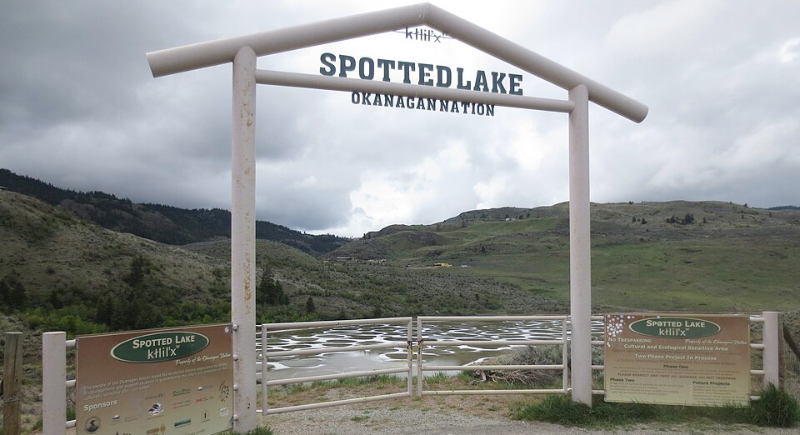
Image via Wikimedia Commons/Extemporalist
Long before outsiders tried to explain the science, the Okanagan First Nations people valued Kliluk as a sacred place. Oral history describes each pool as holding distinct healing properties. The site carried cultural, spiritual, and medicinal importance. In 2001, the land around the lake was secured for the Okanagan Nation to protect it from development and preserve access for future generations.
As of 2025, visitors will notice a fence surrounding the site. It protects fragile ground and honors cultural boundaries. Highway pull-offs provide clear views without risking damage to the mineral crusts. Warm months offer the classic spotted look, but the lake holds meaning year-round for the people connected to it.
Why This Odd Lake Never Gets Old
Since access is limited, most travelers appreciate the view of Kliluk from designated viewing points. However, the overall experience depends heavily on timing. Early summer may show scattered circles, while peak heat reveals the full pattern. Cooler seasons bring back a normal-looking lake that hides its artistic side until the following summer cycle.