
Point Nemo is situated in the middle of the Pacific Ocean, farther from land than any other documented spot on the planet. Its coordinates mark a location surrounded by thousands of miles of open water in every direction, and that isolation has given it an unusual role in modern space operations.
Agencies planning the controlled return of large spacecraft select this remote zone because debris has the highest chance of landing away from inhabited areas and major shipping lanes. The area has gained more attention as the International Space Station prepares for retirement, and space programs confirm that Point Nemo will receive the remaining pieces after the craft burns during descent.
The site has already collected fragments from satellites, research platforms, and decommissioned stations through controlled reentry since the 1970s.
Mapping Out Point Nemo
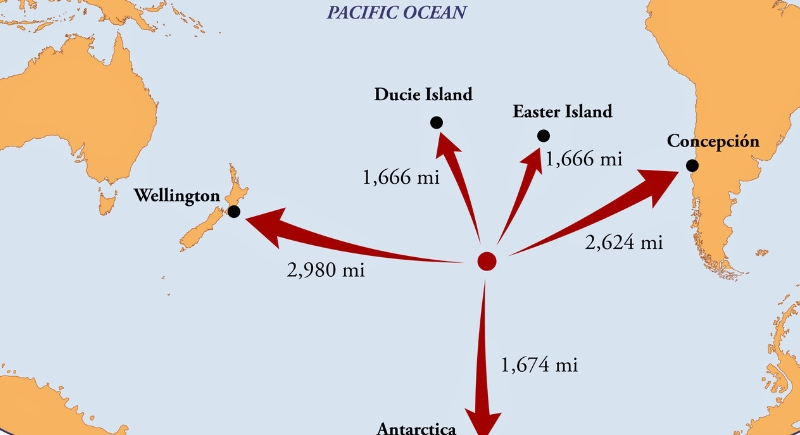
Image via iStockphoto/Dimitrios Karamitros
Point Nemo was identified in 1992 through distance calculations rather than exploration. It lies at 48°52.6 south latitude and 123°23.6 west longitude in the South Pacific between Easter Island and Antarctica. The nearest landmasses are located about 1,670 miles away, including Ducie Island to the north and Maher Island near Antarctica to the south.
This region spans a large area with limited biological activity due to weak currents and low nutrient circulation. Researchers studying the water column report low microbial counts and sparse biodiversity, and ocean surveys describe it as one of the most isolated marine zones measured to date.
How Point Nemo Became A Spacecraft Resting Place
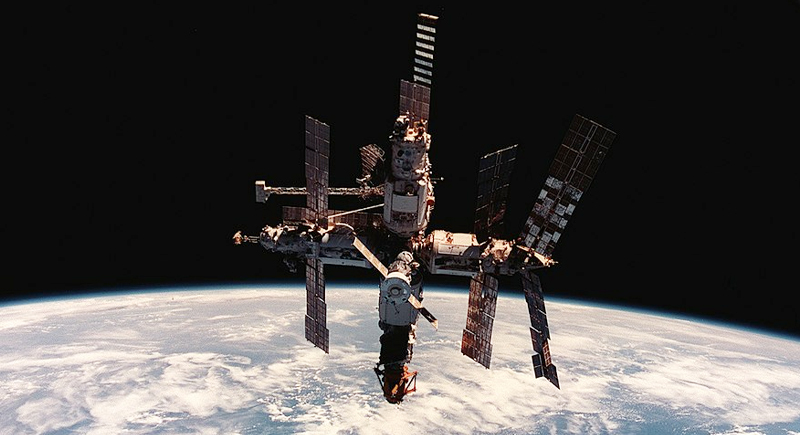
Image via Wikimedia Commons/NASA
Since the 1970s, nearly 300 spacecraft have reentered over this remote part of the Pacific.
Some, like Russia’s Mir space station, were deliberately steered toward the region, while others, including Skylab, entered the ocean here after descending along uncontrolled trajectories. Many burned during descent, while the remaining fragments settled on the seafloor across a wide area.
Controlled reentry planning aims to reduce risk to populated regions. As the number of satellites in orbit grows and tracking improves, the need for predictable end-of-life disposal has also grown. Analysts warn that leaving large structures in orbit increases collision hazards, and the accumulation of debris can interfere with future missions. Returning them to Earth in a managed descent provides a defined outcome.
Why The International Space Station Will Head There
The ISS has orbited Earth since 1998 and has been continuously inhabited since 2000, but its service lifecycle is nearing its endpoint. NASA and partner agencies plan a controlled descent in the early 2030s, with preparations scheduled to begin years in advance. A dedicated deorbit vehicle based on SpaceX hardware will guide the station into its final trajectory.
Due to its size and mass, the ISS cannot rely solely on atmospheric burn-off. Some modules will break apart in the upper atmosphere, but the remaining elements require a designated landing zone. Point Nemo offers a broad margin for safe impact away from flight paths and major shipping routes, and its location simplifies notification procedures for aviation and maritime authorities in Chile, New Zealand, and Tahiti.
What Lies Beneath The Surface
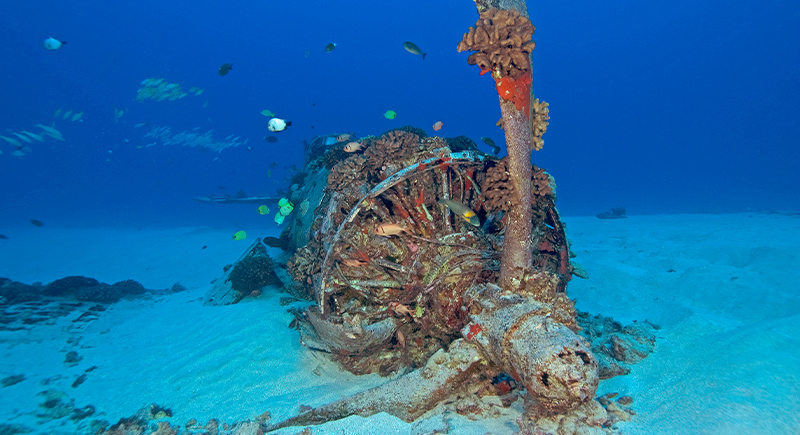
Image via iStockphoto/KGrif
Although the nickname “spacecraft cemetery” is dramatic, the seafloor below Point Nemo contains pieces of stainless steel, titanium, and aluminum reduced by heat and pressure during descent. These materials sink, which limits interference with navigation.
Studies show that the region hosts very little biodiversity, which is one reason it is used for controlled reentry; however, researchers continue to assess the broader ecological implications.
Researchers also track particles released into the atmosphere during reentry and recently identified aluminum traces linked to spacecraft shedding during breakup. All contribute to ongoing discussions about better materials, improved burn profiles, and updated disposal procedures.
Fiction, Trivia, And Cultural References
Point Nemo is not a scientific given name. It was gained through literature, in reference to Captain Nemo of Twenty Thousand Leagues Under the Sea, reflecting isolation rather than character traits. Horror author H. P. Lovecraft created a fictional city in the region, and pop culture creators have referenced its coordinates in music, entertainment, and online sources.
Point Nemo combines geography, aerospace engineering, ocean science, and public curiosity. Sailors passing through during ocean races have collected microplastics at the surface.
As the retirement of the ISS approaches, the zone will continue appearing in news coverage and scientific planning, even though most travelers will never encounter it directly.